You’ve probably had this conversation before, maybe not in a conference room, but in a driveway. Your mechanic just handed you a repair estimate that rivals a car payment, and suddenly the math on that used car doesn’t look so good anymore. The reliable old truck you bought to avoid monthly payments is costing you just as much, sometimes more, than if you’d bought something new and under warranty. Never mind the increased cost of fuel!
Utility owners face this same calculation every day, just with more zeros and longer time horizons. Whether you’re managing a federal water treatment facility, a municipal wastewater system, or an industrial process plant, the question is the same: Is it smarter to put the Cadillac in the ground and forget about it for 50 years or buy the less expensive model and budget for the maintenance that’s coming? The frustrating answer is: It depends. But here’s what shouldn’t depend on anything: Life cycle cost analysis should be part of the design criteria from day one, not an afterthought. And in my experience, it usually isn’t.
The Problem with Capital Thinking
Most infrastructure projects are funded through a capital budget lens. A capital budget covers the up-front cost of building long-term assets—the pipes, pumps, process equipment, and structures—and is separate from the operating budget, which funds day-to-day maintenance and repairs. The two are tracked separately, approved separately, and often managed by entirely different people.
We have all been in enough project kickoff meetings to know how this plays out. Life cycle cost comes up early, usually with genuine enthusiasm. Then the capital budget gets tight, value engineering starts, and the long-term thinking quietly disappears. The person approving the design spec today isn’t necessarily the one explaining the repair bill to a future city council a decade from now. That disconnect is real, and it costs owners money.
A Dollar Today Is Not a Dollar Tomorrow
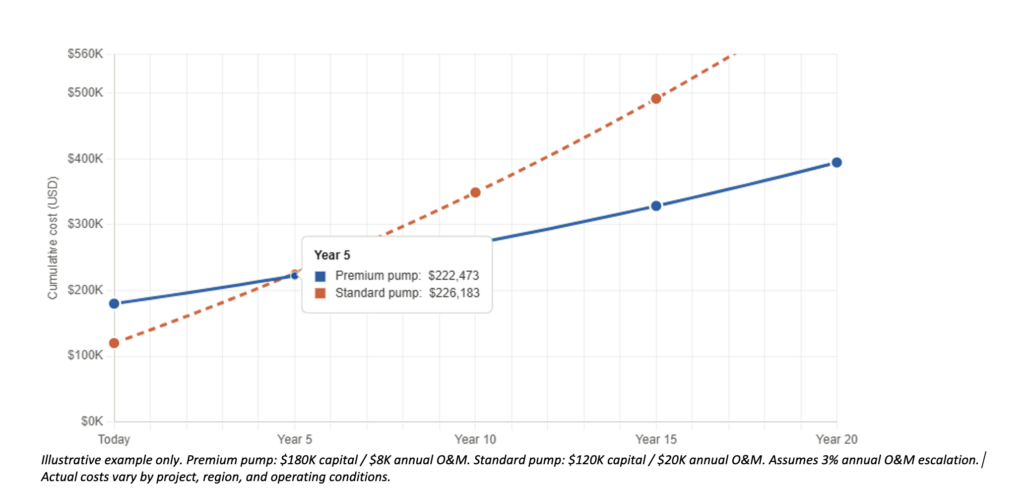
Life cycle cost analysis forces a project team to think in total cost of ownership—what it costs to build, operate, maintain, and eventually replace an asset. When you discount future costs back to present value, the math sometimes surprises you. Consider a high-efficiency pump with a 30-year projected service life and lower energy consumption. It may cost 40% more up front, but over a 20-year horizon it can significantly outperform the less expensive alternative. The same logic applies to clarifier process equipment: Cutting corners on drive mechanisms or wear components might save money at bid time but leads to costly downtime down the road. We’ve all seen clarifier drives fail well before their expected service life simply because selection prioritized cost over reliability. That’s a painful and avoidable lesson.
That said, the analysis doesn’t always favor the premium option. Technology sometimes evolves fast enough that buying less expensive equipment today and planning a refresh in 15 years is the smarter financial call. The point isn’t that one answer is always right; it’s that you can’t know the answer if no one is doing the analysis.
Where Collaborative Delivery Changes the Equation
This is precisely where collaborative delivery—progressive design-build, construction management at-risk (CMAR), and similar approaches—earns its value. When the contractor, supplier, and designer are at the table during the earliest phases, life cycle cost conversations can happen when they still matter and can actually influence the final design.
In a traditional design-bid-build environment, a contractor sees the plans on bid day. By then, equipment has been specified and the decisions that drive 30 years of operating cost are locked in. There’s no mechanism for a construction partner to say, “If we shift to this alternative, here’s what your maintenance crew will thank you for in year 15.” Collaborative delivery creates that mechanism, putting real numbers in front of the owner before anything is committed to paper.
Making It a Criterion, Not a Conversation
Owners serious about long-term asset performance are starting to include life cycle cost requirements in their project delivery documents, not as a checkbox, but as a genuine evaluation factor. We see this in federal design-build pursuits through best-value proposal evaluations. Forward-thinking municipalities are doing the same. Industrial clients who operate on thin margins came to this conclusion years ago.
Don’t get me wrong, the goal isn’t to always choose the most expensive option. It’s to make sure the decision is informed. Just like that car in the driveway, sometimes the new one with the warranty is the right call and sometimes the reliable workhorse still has plenty of miles left. But you should know which one you’re buying before you sign the papers.
Life cycle cost analysis isn’t a nice-to-have. It’s a design criterion. Treat it like one.