
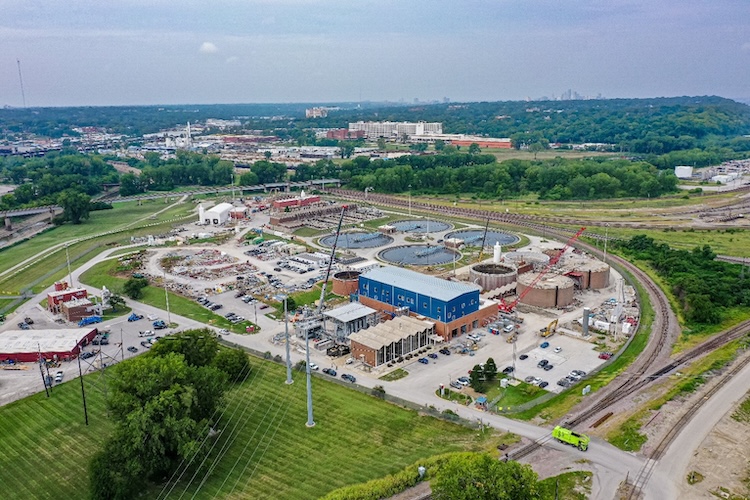
Fixed-price design-build (FPDB) can deliver the price certainty that boards and city councils expect and the collaboration that complex water programs require, especially if the commercial model is paired with smart building information modeling (BIM) and disciplined, model-based behaviors. Kansas City’s Blue River Wastewater Treatment Plant (WWTP) Biosolids Facility Improvements project illustrates how this combination moves beyond “faster delivery” to measurable life cycle value.
Why FPDB now—and what’s been missing
FPDB gives owners a committed price early and concentrates accountability. When procured well, it encourages innovation through competition. Water Collaborative Delivery Association (WCDA) and Design Build Institute of America (DBIA) guidance shows that success hinges on clear performance criteria, best‑value selection, and early constructor/design integration to avoid “price‑first, align‑later” pitfalls.
What’s often missing is a system of practice that preserves collaboration after award. That’s where smart BIM, a term used for the project to drive BIM objectives forward (a governed, information‑rich model used for decision-making), improves operations via the FPDB contract.
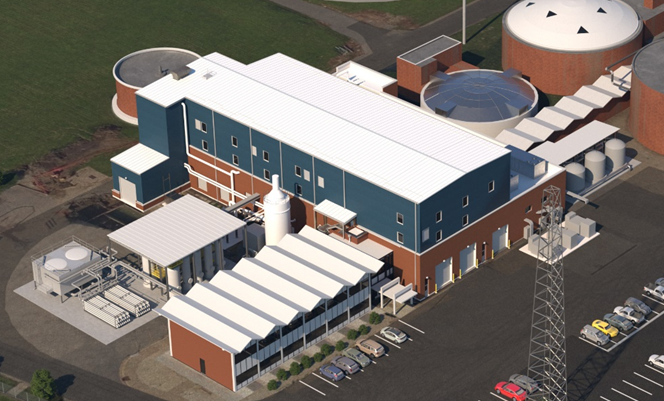
BIM model rendering
How smart BIM unlocks FPDB value
A single source of truth for scope. As a coordinated model aligned to process intent, access/ergonomics, and operation and maintenance (O&M) needs, FPDB reduces ambiguities that drive claims and change orders. Owners can accept or reject scope with visual clarity, keeping the fixed price fixed.
Model‑based gates that replace “hope with proof.” Formal design, constructability, operability, and safety reviews happen in the model, not in 2-D markups. Decisions are anchored to geometry, quantities, and constraints, improving decision speed and reducing downstream rework. This grounds decisions in a true sense of reality, offering complete clarity not only about the dimensional limitations of the space but also a tangible sense of presence. It allows people to genuinely experience what the space will feel like, making it easier to relate to, enabling more meaningful feedback, and ultimately driving more predictable outcomes.
Contractor‑extended models for the field. When the builder enriches the design model for quantities, shop drawings, and layout, errors shrink, RFIs drop, and the price certainty promised by FPDB can materialize.
A foundation for asset management and digital twins. If the model is structured from day one for tags, metadata, and hierarchy, owners can hand off a data asset that plugs into EAM/CMMS and eventually SCADA, which provides a platform that can enhance performance. We’re entering a new era of facility management—one built on a strong digital foundation. By structuring models to support operations use cases from day one, including asset hierarchies, asset tags, and metadata, the handover package becomes far more than a set of drawings. It evolves into a true digital twin that can integrate with IT/OT data and unlock new spatial intelligence and insights for the facility. Putting BIM data to work is now more seamless and impactful than it has ever been.
Proof points from Kansas City’s Blue River WWTP
KC Water replaced an aging, multi‑hearth incineration facility with thermal hydrolysis process (THP) technology, producing Class A biosolids and enabling energy recovery. Following are features and benefits of the project’s use of smart BIM with FPDB.
- Model‑based reviews under FPDB. The team reused the old incineration building’s foundation, a constraint that demanded rigorous model‑based design and operability and constructability checks to validate access, sequencing, and safety in tight quarters.
- Contractor extensions. Proposal documents by Goodwin Brothers Construction, the project’s design-build general contractor, included a plan to use the BIM model for design packages, quantities, 4D scheduling, machine control, startup, and to synchronize P&IDs and equipment data with the city’s CMMS—precisely the behaviors that de‑risk field delivery under a fixed price.
- Field layout from the model. Goodwin Brothers used direct model‑to‑survey workflows to limit errors in field locations. For example, 159 helical piles were installed in the existing building foundation slab, and all were located using coordinates directly from the model.
- Life cycle data handoff. KC Water plans to transition the coordinated model into an owner’s data asset, with a roadmap toward SCADA integration.
- Performance scale. The Blue River WWTP Biosolids Facility Improvements project is designed for up to 94 dry tons/day of solids processing with THP, centrifuge dewatering, and supporting systems. This is evidence that smart BIM practices can scale to large, multi‑train facilities without losing decision quality.
Five FPDB + Smart BIM practices WCDA members can adopt now
1. Make the model contractual. Define the model as a governed project artifact with level-of-development targets, review gates, and acceptance criteria tied to pay items and change management. Use WCDA and DBIA best practices to align roles and responsibilities.
2. Run multi-party model reviews. Institutionalize recurring owner-designer-builder sessions focused on access/egress, maintainability, operability, and safety—recording decisions in the model issue log (not email).
3. Recommend contractor/supplier model extensions. In the RFP, specify BIM-based coordination including use for takeoffs, LOD 40 (fabrication‑level detail), clash‑free spools, and direct export to survey/machine control. Blue River’s approach provides a template.
4. Design for the owner’s data future. Specify tag standards (process and instrumentation drawing {P&ID} to 3D to CMMS), asset hierarchies, and metadata so the as‑constructed model drops into EAM now and connects to SCADA later. This enables a practical digital twin that becomes a tool for operations and maintenance staff. Identify champions within each party to ensure that data is being captured, validated, and produces expected outcomes from the start of the project. Make it a real position, with real focus, if you want real results.
5. Tie funding confidence to digital transparency. Structured model governance, quantity traceability, and construction rehearsal artifacts support funders’ diligence, reinforcing affordability narratives for tools like WIFIA.
Bottom line
Fixed-price design-build delivers price certainty. Smart BIM can help the team keep that promise without sacrificing innovation or operability. As the Blue River WWTP Biosolids Facility Improvements project in Kansas City shows, when owners specify model‑based behaviors, including design/constructability/safety gates, contractor model extensions, and life cycle data standards, the result can be safer delivery, fewer surprises, and a digital asset that keeps paying dividends long after ribbon‑cutting.