Across the country, municipality owners face a relentless challenge: delivering critical infrastructure quickly enough to outpace rising demand. Too often, expansion programs are a veritable whack-a-mole of challenges emerging faster than they can be resolved, namely long-lead times, unpredictable population growth, and evolving flow projections. The North Texas Municipal Water District’s (NTMWD’s) service area is no exception, but it has found the right team to wield the mallet.
Case Study of a Standout Team
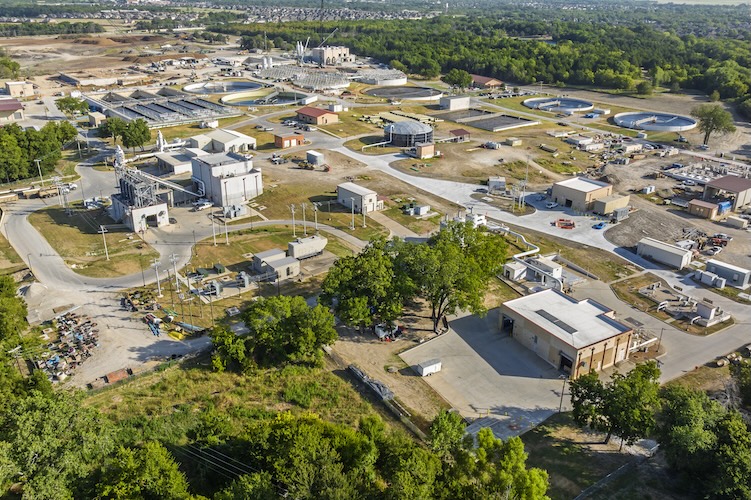
At the South Mesquite Creek Regional Wastewater Treatment Plant (RWWTP), where expansion is critical to staying ahead of peak-flow demands, Archer Western Construction and Carollo Engineers are delivering a construction management at-risk (CMAR) project that will increase treatment capacity from 33 to 41 mgd and increase peak-flow handling capacity to meet projected 2033 growth.
Together with AECOM, NTMWD’s owner advisor, the team has built its approach around trust, technical competency, strong local relationships, and hard work. By understanding the plant’s constraints, anticipating capacity limitations, and advancing creative solutions before those limits are reached, the team has become a trusted partner that NTMWD can rely on. One of the clearest examples of this proactive and collaborative approach was the early delivery of Peak Wet-Weather Flow Basins No. 1 and No. 3.
While providing additional wet-weather storage capacity was always a project objective, the team worked together to develop an alternative delivery strategy that allowed both basins to be placed into service well before substantial completion of the expansion projects. The second basin has been operational since December 2025, despite the project’s February 2027 substantial completion date.
This effort was established as a priority early in the project and has since provided an additional 6.9 million gallons of peak-flow storage capacity. As a result, plant operations can divert excess wet-weather flows without overwhelming the existing treatment system, reducing operational risk and eliminating concerns over available storage capacity during major storm events. By bringing this critical infrastructure online ahead of schedule, the team delivered immediate value to the owner, improved operational flexibility, and demonstrated how a unified project team can achieve outcomes that would be difficult to realize through a traditional delivery approach.
This team’s dynamic should not be unique. Successful collaboration is what owners expect from collaborative delivery teams, though it is not always what they experience. So what makes this team work and how can that approach become the industry standard? How can project teams consistently deliver results that their clients expect?
The answer is not complicated. Success is achievable on every project—with the right team and strategy.
People Matter, and Results Will Follow
Duplicating the Outcome
- Lose the Attitude (The No-Ego Zone)
“Teamwork begins by building trust,” writes Patrick Lencioni in his book The Five Dysfunctions of a Team, “and the only way to do that is to overcome our need for invulnerability.” After all, acknowledging the monster in the closet is the first step to slaying it. Successful collaborative delivery teams step up by conceding that as individual firms they do not have all the answers. Teams willing to be vulnerable are united by a common objective: finding the best solution together.
When problems arise, it is easy to fall into an “if you want the job done right, you’ve got to do it yourself” mindset. The strength of the South Mesquite team lies in rejecting that instinct. To do the job the best, each member needs the others to be at their best. - Developing Goals as One Team
Too often, project goals are not truly established until after the bid is won. But for a collaborative delivery team, winning the project is not the job—building it successfully is.
Archer Western and Carollo began assembling a strong team early on, deliberately selecting the people and capabilities needed to execute every aspect of the work. That same discipline should carry through the entire team: a thoughtful organizational structure, clearly defined roles, and a plan for how the group will operate together before the pressure of execution begins.
The objective should also extend beyond the completion of a single project. Successful teams build relationships with the owner and establish themselves as trusted partners for what comes next. South Mesquite Creek RWWTP is one project in a much larger effort to provide reliable wastewater infrastructure for the North Texas community. From the outset, the team approached the work with a long-term mindset: Deliver this project well enough to earn the opportunity to build the next one—and the one after that.
That preparation matters when it is time to execute. At notice to proceed, construction managers must be able to mobilize quickly and put the right people on the ground without losing momentum. Archer Western planned to allocate the best crews well in advance so that when the project was ready to move, the team would be ready with it.
One of the clearest benefits of the collaborative delivery approach has been the team’s ability to identify, prioritize, and accelerate critical project components that can provide immediate value to the owner. Rather than treating the project as a single sequence of work with benefits realized only at final completion, the team has worked together to bring key wet-weather improvements online early, including peak-flow storage that the owner has since relied on dozens of times while improvements continue to be constructed. Achieving that early functionality required the team to look beyond conventional sequencing, evaluate opportunities across both existing and new infrastructure, and align design, construction, operations, and commissioning around a common objective. That intentional flexibility allowed the project to begin delivering meaningful benefits well before final completion, illustrating one of the most powerful advantages of collaborative project delivery. - From Competitors to Collaborators
Water challenges don’t stop at project boundaries, and neither should collaboration. Strong subcontractor relationships, established work histories, and early coordination bring valuable partners to the table, turning competitors into contributors and strengthening the project’s delivery model.
The South Mesquite RWWTP project team has a track record of bringing trusted partners together to deliver complex projects. For a CMAR, developing a reputation among subcontractors for fairness, competence, and reliability directly affects the quality of teams willing to pursue and perform the work. This consistency is apparent at the South Mesquite RWWTP, where local contractors win and successfully execute multiple work packages.
The Right Team, The Right Attitude
Every project should run as smoothly as the expansion of the South Mesquite Creek RWWTP in North Texas, yet too many do not. What makes this team’s success notable is not accidental; it is achievable, repeatable, and scalable. The team is deliberate about clearing the obstacles that derail projects: egos, misaligned expectations, rigid processes, poor planning, bureaucracy, mistrust, and bad actors. Each creates friction; together, they can bring progress to a crawl.
Today’s water infrastructure challenges are too large and complex for any one organization to solve alone. As collaborative delivery continues to expand, advisors like WCDA are helping owners move toward more integrated delivery approaches that emphasize team collaboration over confrontation and position the entire team around a shared outcome.
A project’s success is often judged by how teams respond when problems arise. However, the best teams do more than solve problems well; they build the trust, alignment, and relationships that allow problems to be addressed before they threaten the project. When strong, cohesive relationships are built intentionally from the start, exceptional outcomes become far more repeatable.