Risk is an inherent part of wastewater projects. What changes from one delivery model to another is not whether risk exists, but when key decisions are made and who is involved in making them.
One of the most consequential decisions in a wastewater project is the selection of the treatment process. While that decision is guided by technical requirements, it is equally shaped by operational experience, site constraints, and delivery considerations. For expansion projects in particular, owners are rarely starting from zero. They bring years of experience and often have a clear sense of what has worked well at their facility. The challenge is not always in deciding what they want, but ensuring that decision can be delivered efficiently, affordably, and without introducing avoidable risk.
This is where delivery model choice can matter as much as technology itself. That reality framed a recent wastewater treatment facility expansion delivered using a progressive design-build (PDB) model. By selecting PDB, the owner enabled a framework that allowed design and construction expertise to be engaged early—not to determine the technology choice, but to validate how that choice could be delivered efficiently before design and pricing were finalized.
An expansion grounded in operational experience
The project involved expanding an existing wastewater treatment facility to meet growing capacity needs. The owner and operator had direct experience with their current biological treatment process and were satisfied with its performance, operability, and maintenance requirements.
Several priorities shaped early planning:
- Maintaining continuity with an approach the operations team understood well
- Keeping the expansion within an existing fenced footprint
- Minimal disruption to ongoing plant operations
- A clear and executable path for further future expansions
From the outset, the owner’s objective was not to explore new technology options, but to confirm that extending a proven approach could be executed efficiently within the project’s constraints.
Why delivery model choice still mattered
In theory, an owner with a clear technology preference could pursue a traditional design-bid-build (DBB) approach and specify that solution directly. In practice, however, knowing what you want does not always provide clarity on how best to deliver it. Questions around constructability, sequencing, schedule, and cost certainly often emerge only after design advances and contractor input is received. At that stage, addressing those realities uncovers risks that can require redesign, schedule extensions, or cost adjustments—even when the technology selection was sound.
Progressive design-build changed the timing of those key conversations.
By engaging design and construction expertise early, the project team was able to validate the owner’s preferred approach against real-world delivery considerations before design and pricing were locked. This early validation provided clarity on constructability, confirmed alignment with site constraints, and reduced the likelihood of late-stage changes.
In this case, PDB was not used to select the technology, but to confirm that the technology the owner preferred could be delivered efficiently and responsibly.
Confirming the right fit—early
Within this framework, the project team evaluated how best to meet the expansion needs while staying consistent with the owner’s operational preferences and site constraints. Because the owner had already implemented and operated one of our proprietary biological treatment processes, familiarity played an important role in the discussion.
Key factors included the following:
- Ease of operation and maintenance
- Compact footprint that fit within the defined expansion boundary while preserving room for future expansions
- The ability to add capacity in defined increments as needs evolve
Addressing these factors early allowed the project team to confirm direction with confidence, rather than revisiting foundational decisions later when flexibility would have been limited.
Speed enabled by clarity
One of the notable outcomes of this approach was schedule performance. With early agreement on direction and delivery implications, the project moved quickly from planning to execution. With early alignment on delivery implications and fewer late-stage unknowns, the project was able to maintain momentum from planning through execution. Speed, in this case, was a result of early clarity and alignment rather than compressed decision-making.
A takeaway for owners and practitioners
This project illustrates an important benefit of the progressive design-build model, particularly for expansion projects. It provided a structured way for the owner to retain influence over critical decisions, while engaging design and construction expertise early enough to validate those decisions as commitments are made. For expansion projects built on existing experience, that early validation can help reduce downstream surprises and support more predictable delivery.
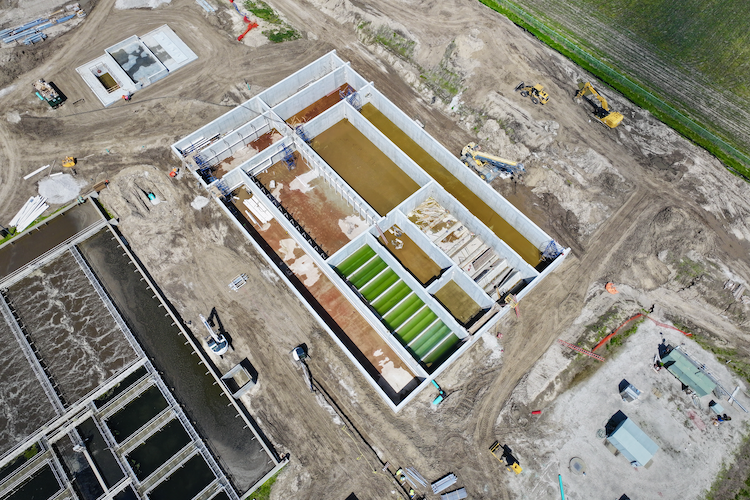
Photo: The owner’s operational preferences, established at the outset (replicating the existing process, left, with the new expansion, right) drove the rapid and efficient execution of the project.