
The bids were open and one number sat well below the rest. The contractor was known for bidding low and recovering margin through change orders. As a water utility general manager, I also knew my options were limited and what could follow: disputes, staff time consumed by claims, and an owner-contractor relationship that began with caution instead of trust.
At that point in my career, I did not have an early opportunity to choose a team based on qualifications and work with that team while scope, risk, schedule, and price were still taking shape. I could only follow the traditional low-bid process and hope this project would be different or prepare for an adversarial experience.
A Better Starting Point
Years later, working with progressive design-build (PDB) gave me a different perspective on that experience. PDB does not eliminate project problems, guarantee collaboration, or make risk disappear. What it can do is give owners an opportunity to bring the designer and builder into the discussion earlier. Combining design and construction under one contract is part of it, but the real value comes from working through the project together—agreeing on what success looks like, testing assumptions, and making decisions while there is still room to adjust the design and approach.
Choose the Team Before the Solution Is Fixed
Using PDB, owners can select a team based on its qualifications, proposed approach, and ability to work together. For a utility general manager, that means choosing the people who will help develop the solution before the design is complete and a construction price is committed.
Competition and accountability still matter. The owner needs a sound selection process and a clear basis for evaluating the team’s performance and proposed price as the project develops.
Address Risk While There Are Still Options
Water and wastewater projects come with uncertainty. Existing conditions may not be what you expected. Treatment performance has to be demonstrated. Labor and equipment availability can affect both cost and schedule. Some of those issues won’t become apparent until construction is underway.
Having the designer and builder involved during Phase 1 gives the team an earlier opportunity to investigate those construction challenges, compare alternatives, and determine who is best positioned to manage each risk.
A risk register can help document those discussions, but its value depends on what the team does with it. The owner needs to understand which risks remain, who is responsible for addressing them, and when decisions are needed.
Surprises can still happen. The opportunity is to address more of the uncertainty while the team still has choices.
Develop Scope, Schedule, and Price Together
PDB is sometimes described as providing cost certainty or schedule savings, but I think that oversimplifies it.
As the design develops, the team can update estimates and compare alternatives against the owner’s priorities and available budget. That gives the owner a chance to make informed tradeoffs before advancing too far with a solution that breaks the budget.
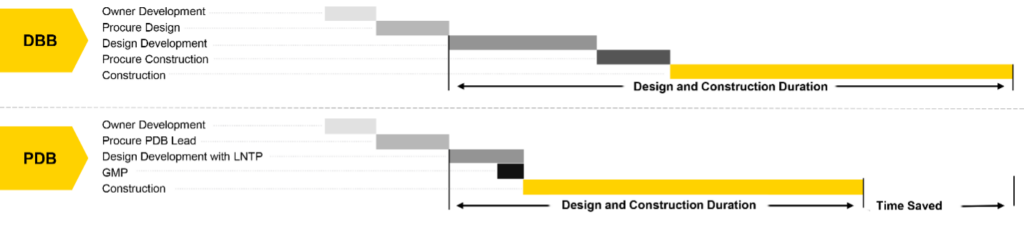
The same is true of schedule. Long-lead equipment can be identified while design is still progressing, and the team can consider whether early procurement or an early work package makes sense. Design, procurement, and construction may also be able to overlap where doing so provides a real schedule benefit. But before moving forward with early work, the parties should understand who is responsible for procurement, installation, warranties, and coordination with the rest of the work.
As shown below, the opportunity to shorten the schedule comes from identifying where design, procurement, and early construction can reasonably overlap—with the owner and design-builder working through the risks together.

The Owner Still Has Work to Do
PDB doesn’t put the project on autopilot. PDB requires an owner who is prepared to participate, empowered to make timely decisions, and ready to work through difficult issues. Clear decision authority, transparent cost development, and a fair process for agreeing on price are all part of that.
There will still be disagreements. Bringing the team together earlier gives the parties a chance to work through them with more information and, often, more options. The owner’s leadership matters throughout that process.
What I Would Want Before the Next Bid Opening
Thinking back to that bid opening, I would have wanted an earlier opportunity to choose the team and understand the issues that could affect our project. I would have wanted the people responsible for designing and building it to help us evaluate those issues before our options became more limited.
That is why I think utility leaders should understand PDB before deciding how to deliver their next critical project. The delivery method affects when the owner gets input from the designer and builder, what information is available, and which decisions need to be made along the way.
For an owner facing a complex project, I’d start with this question: When would input from the people who will design and build the project be most useful to us?