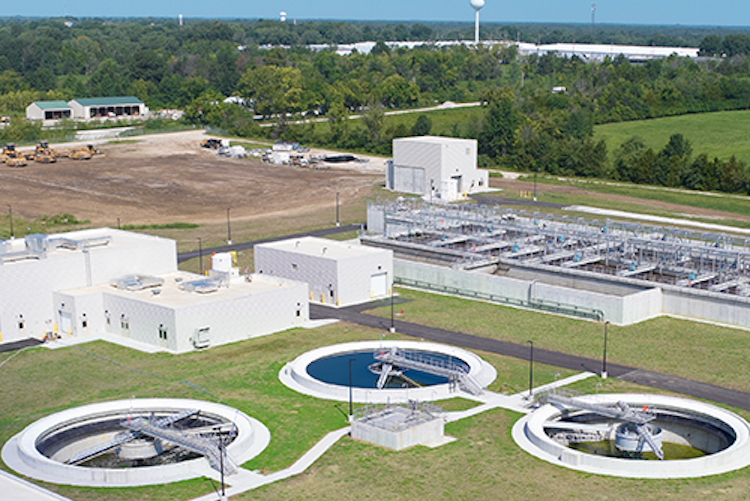
When major industrial development meets limited public utility capacity, communities must find new ways to deliver infrastructure faster, smarter, and with fewer unknowns. The Wright City (Missouri) Wastewater Treatment Facility, delivered by the Alberici and Woodard & Curran joint venture for American Foods Group (AFG) and Public Water Supply District #2 (PWSD2), is a clear example of how progressive design-build (PDB) transformed that challenge into an opportunity for innovation and partnership.
A Delivery Model Built for Urgency and Complexity
Traditional design–bid–build could not meet the aggressive timeline required to support AFG’s new 1.5 mgd beef-processing facility or Wright City’s projected growth. The existing lagoon system was both undersized and inflexible, and the community needed a path to accelerate planning, design, and construction. Progressive design-build provided that path.
Through early engagement, transparent alignment of goals, and integrated decision-making, the owner, engineer, contractor, and trade partners advanced from concept to construction without the delays inherent in linear project delivery. This collaborative structure allowed the team to jointly assess risks, refine scope in real time, and optimize solutions based on constructability, cost, and operational durability.
Technical Excellence Accelerated Through Collaboration
Many of the facility’s most sophisticated features were only achievable because the PDB process brought experts to the table early, long before design decisions became irreversible.
The heart of the plant, a four-stage Bardenpho biological nutrient removal (BNR) system with side-stream phosphorus removal, required precise sizing, biological modeling, and hydraulic integration of both municipal and high-strength industrial flows. With PDB, the contractor, operator, and designer collaborated from the outset to shape zone volumes, pumping strategies, and chemical dosing locations, ensuring the system could adapt to variable loading and achieve stringent effluent limits.
Similarly, decisions around tertiary filtration, UV disinfection, aeration technology, solids handling, and facility power supply benefited from a unified approach. Early involvement of mechanical and electrical trade partners enabled the following:
- Selection of highly efficient mixer/aerators for energy-efficient oxygen transfer
- Integration of 10-micron cloth media disk filters positioned indoors for year-round reliability
- Design of UV disinfection modules removable without entering channels, improving safety and maintenance
Having two major electrical buildings provided power distribution across the large site closer to where the power demand was located. This greatly reduced large conductor lengths and aligned switchgear sizing with the generator sizing that was available in the market to meet the project’s schedule.
These solutions were not simply designed, they were co-created, aligning technical performance with constructability, dynamic market conditions, and operational practicality.
Managing Constraints Through Integrated Problem-Solving
The project site presented challenges, including Federal Emergency Management Agency (FEMA) floodplain restrictions, continuous operation of the existing lagoon system during construction, and dual influent streams with dramatically different characteristics. Through PDB’s iterative model, the team evaluated alternatives collectively, enabling fast, informed decisions such as elevating all major structures above the 100-year floodplain and configuring flexible screening, pumping, and equalization strategies to manage industrial peaks and future municipal expansion.
A Model for Fast, Future-Ready Water Infrastructure for Projects of All Sizes
Delivered in only 18 months and meeting all regulatory and performance goals, the Wright City facility now provides 3.5 mgd of integrated capacity, protects the Peruque Creek watershed, and positions the region for sustainable growth. More importantly, it demonstrates the power of progressive design-build to unite public and private stakeholders, reduce risk, accelerate delivery, and unlock innovative solutions that traditional methods simply cannot achieve.