Hillsborough County, Florida, is in the midst of a cultural and operational shift—one that is reshaping how the utility approaches major capital work, organizational training, and long-term resilience. At the center of this shift is a clear message: Collaborative delivery works best when teams arrive ready to engage, listen, and solve together.
In a recent discussion with Hillsborough County Public Utilities’ Lisa Rhea, Water Resources Director, and Elizabeth Keddy, Capital Projects Section Manager, several themes emerged about why the County has pivoted toward collaborative delivery, why construction management at-risk (CMAR) has become a preferred method, and what qualities they value most in future partners.
Strategic Direction: Building a More Resilient Utility Through Collaboration
When asked how collaborative delivery supports Hillsborough County’s future, Rhea pointed to one core idea: Utilities become more resilient when more people are engaged. That engagement—between engineers, contractors, operations staff, and internal divisions—leads to better decisions and better long-term outcomes.
The County sees CMAR as a mechanism to bring multiple lenses to the table early:
- The engineering perspective
- The contractor’s current understanding of market conditions and price escalation
- The operations viewpoint, which ultimately lives with the asset
With rising costs and shifting availability of materials, early cost estimating and early value engineering are essential. As Rhea put it, quoting the old African proverb, “If you want to go fast, go alone. If you want to go far, go together.” Collaborative delivery allows the County to go far—toward long-term resilience, life cycle cost optimization, and the best operational results for ratepayers.
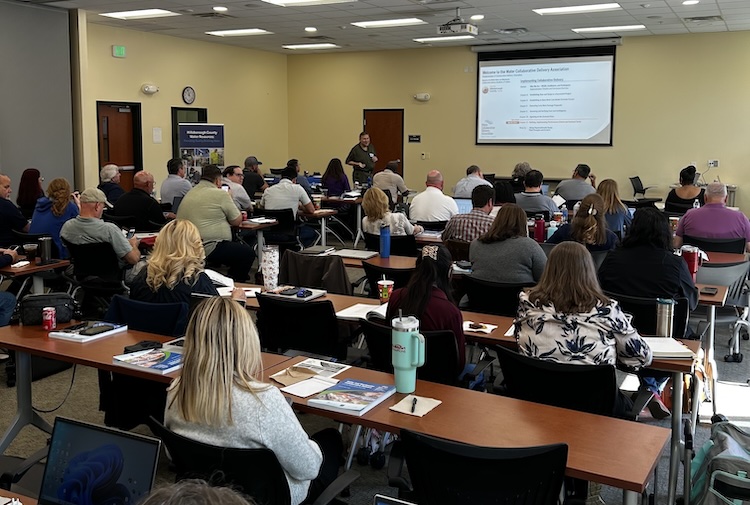
Current Priorities: Why Hillsborough County Hosted A WCDA Training Series
The County’s decision to host a WCDA training series stemmed from a simple realization: You can’t move a big ship without training the people steering it. Staff across the utility understood pieces of collaborative delivery, but the County needed consistent fundamentals, a deeper dive into CMAR, and insight into how these approaches transform the entire project life cycle.
Key motivations included the following:
- Equipping staff with tools and knowledge they didn’t have
- Strengthening understanding of how CMAR decisions impact design, construction, and operations
- Reinforcing internal buy-in across all divisions—not just leadership
- Intentionally mixing groups to break silos and broaden perspectives
- Ensuring operations staff fully understand how their early input shapes project outcomes
This culture shift wasn’t theoretical. When emergencies hit (e.g., hurricanes), divisions that traditionally worked independently stepped in to support each other, creating a natural collaborative momentum. As they joked, the process fits nicely with being a Tampa pirate—because it was truly “all hands on deck.” That spirit has become part of the County’s identity.
Lessons Learned: What Future CMAR Partners Should Understand
The County’s experience points to clear lessons for industry partners:
- Silos must be dismantled. Collaboration cannot exist when divisions or firms operate in isolation.
- Early alignment is critical. Success hinges on designers, contractors, and operations teams engaging early and often.
- Transparency sets the tone. Cost drivers, risks, and technical decisions must be shared openly—not guarded.
- Listening is a differentiator. The best partners listen not just to respond, but to understand.
Risk & Contracting Expectations: A More Collaborative Philosophy
A pivotal moment in the County’s shift toward CMAR came from a direct, honest question: Why wasn’t Hillsborough County receiving bids?
The market responded loud and clear: Hard-bid procurement no longer matched industry realities.
This catalyzed the County to rethink risk and contracting. Procurement, risk management, and utilities teams all engaged in significant internal work, though at times they found themselves stuck within legacy processes.
Moving toward CMAR clarified the path forward. The County’s philosophy now centers on allocating risk to the party best able to manage it, but doing so in a collaborative way, not an adversarial way. Partners who align with this philosophy—open communication, shared goals, and realistic risk distribution—will thrive.
Future Partnerships: What Qualities Matter Most?
When asked to summarize Hillsborough County’s expectations for future partners in a single word, Lisa Rhea didn’t hesitate: teamwork.
She followed that with open-mindedness.
To the County, teamwork means:
- Approaching challenges with curiosity
- Staying receptive to new ideas
- Offering solutions rather than defending positions
- Sharing accountability
- Staying aligned with the County’s mission to serve ratepayers and the community
Keddy agreed wholeheartedly. Teamwork isn’t just preferred—it’s required.
Why This Matters Now
Hillsborough County is not embracing collaborative delivery because it is trendy or convenient; they are embracing it because the water industry—and the needs of the community—require a new level of partnership, integration, and trust.
Without teamwork, CMAR becomes a contract. With teamwork, CMAR becomes a pathway to resilience. Hillsborough County is committed to choosing the path that brings people together, strengthens outcomes, and prepares the utility for the future.