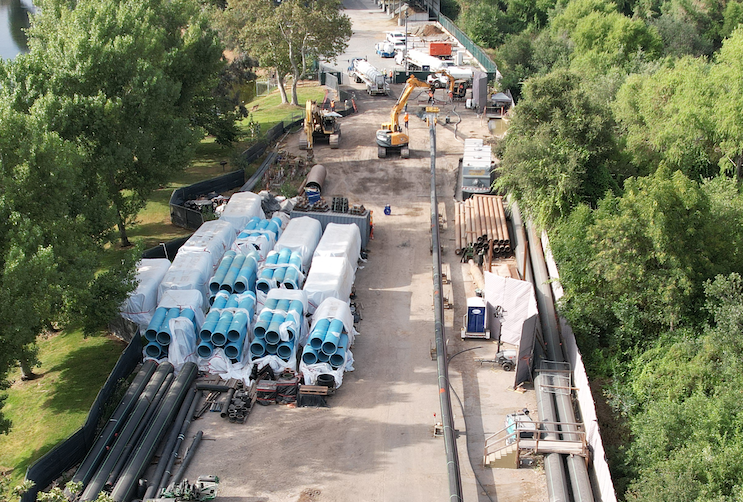
Why do some trenchless installations proceed smoothly while others face delays, environmental concerns, or costly redesigns? For many water and wastewater agencies, trenchless construction offers an attractive alternative to open-cut work—especially when crossing water bodies, sensitive habitat, or dense urban corridors. Yet these benefits come with an elevated risk profile. Subsurface unpredictability, groundwater, long drill lengths, and strict environmental requirements all complicate trenchless work.
Collaborative delivery has emerged as one of the most effective tools to navigate these challenges. Across the industry, owners and delivery teams are learning that risk on trenchless projects isn’t just a technical problem—it’s a communication, coordination, and decision-making problem. And those are precisely the areas collaborative delivery strengthens.
Understanding the Risk Profile of Trenchless Construction
Whether performed through horizontal directional drilling (HDD), sliplining, or microtunneling, trenchless construction brings unique engineering and environmental complexities. Highly variable alluvial soils can shift from granular to cemented conditions within feet. High groundwater pressures can reduce overburden, destabilize boreholes, and contribute to inadvertent returns (IRs). Long drill paths increase annular pressure changes, drilling fluid losses, and pullback stresses on product pipe. Even with strong designs, field conditions can evolve rapidly.
These challenges are not new, but our ability to manage them is improving. Collaborative delivery models, particularly progressive design-build (PDB), allow project teams to engage specialty trenchless contractors earlier, test assumptions together, and plan around real-world ground behavior rather than idealized design scenarios.
Why Collaborative Delivery Changes the Game
1. Early contractor involvement improves technical assumptions.
In traditional delivery, designs may advance before trenchless specialists weigh in on constructability. Under collaborative delivery, HDD and microtunnel subcontractors participate early, helping refine alignment geometry, casing requirements, drilling fluid strategies, and risk registers. This results in more realistic plans and fewer surprises when construction begins.
2. Integrated communication enables rapid response.
Trenchless work often requires quick decisions—whether adjusting drilling pressures, altering reaming sequences, or responding to emerging settlement. Real-time communication among the owner, contractor, environmental monitors, and engineer allows the team to course correct immediately. This was evident in a recent Southern California potable reuse program, where repeated IR events were successfully contained because environmental monitors, drill operators, and the owner advisor worked as a single response team.
3. Design flexibility reduces the impact of unforeseen conditions.
Collaborative delivery also strengthens the ability to adapt designs when the subsurface behaves unexpectedly. When casing advancement encountered refusal and created surface instability on one major HDD alignment, the project team could reassess soil conditions, modify bore strategies, and ultimately plan a revised alignment—all without halting progress on other project components. Flexible design isn’t just a convenience on trenchless projects; it’s a necessity.
4. Shared ownership of risk lowers the temperature.
A hallmark of collaborative delivery is the shared approach to problem-solving. Rather than debating responsibility when issues arise—such as a bundled pullback that overstresses smaller conduits—teams in a collaborative environment can jointly analyze root causes and adjust methods. This creates a culture where learning and adapting outweigh blame or claims.
What Owners, Regulators, and Contractors Can Take Away
For Owners:
Collaborative delivery offers visibility into risks earlier, helping agencies make informed decisions about alignments, construction windows, and contingency plans. It also reduces the likelihood of major change orders by grounding design in real-world constructability.
For Regulators:
Integrated teams maintain clearer communication with permitting agencies and can respond quickly to IRs, open-channel impacts, or habitat concerns. This builds trust and ensures compliance measures are implemented consistently.
For Engineers and Consultants:
Trenchless projects demand flexible design thinking, robust geotechnical investigation, and continuous verification during construction. Collaborative delivery supports this by creating a feedback loop between office and field.
For Contractors:
PDB and other collaborative models give trenchless subcontractors a seat at the design table, empowering them to suggest methods that reduce risk and improve productivity. This reduces the chance of reaching irrecoverable conditions during drilling or pullback.
Why This Matters Now
Agencies across the country are relying more heavily on trenchless construction to expand, rehabilitate, and harden critical water infrastructure while minimizing surface impacts. As projects become longer, deeper, and more environmentally sensitive, the risks associated with trenchless work increase accordingly. Collaborative delivery is not just a contractual structure—it is a practical risk-management tool that strengthens technical decisions, improves environmental stewardship, and accelerates resolution when unexpected conditions arise.
In the world of trenchless installations, the difference between success and struggle often comes down to how well the team collaborates. When owners, designers, regulators, and contractors share information freely and adapt together, even the most challenging subsurface conditions can be managed with confidence.