Complex construction projects—particularly those involving emerging regulations, specialized equipment, or site-specific treatment requirements—demand more than a traditional design-bid-build approach. When the stakes are high and the variables are many, early collaboration between the owner, engineer, and contractor is not just beneficial, it is essential. A well-structured collaborative delivery approach guides the team in making better decisions, avoiding costly surprises during installation and start-up, and controlling long-term costs.
Few project types illustrate this better than drinking water treatment, where utilities are currently racing to meet EPA mandates for removing PFAS compounds from drinking water by 2029. These projects are expensive, highly site specific, and dependent on specialized equipment in limited supply, all conditions that put enormous pressure on traditional sequential delivery. Collaborative delivery is proving to be a key accelerant in moving these projects from planning to operation efficiently and successfully.
Early Involvement Produces Better Decisions
On complex projects, the conditions that define a project—source water quality, site constraints, regulatory requirements—vary significantly from one location to the next. When it comes to PFAS removal, utilities often pilot several technologies to determine what works best for their conditions. Because PFAS treatment is expensive, selecting equipment that operates efficiently can provide significant savings over the life cycle of the project. Bringing cost, constructability, operations, and design expertise into the conversation while the project work plan is still under development leads to better early decisions and avoids expensive course corrections later. Owners, engineers, and contractors each bring a distinct lens, and collaborative delivery ensures all three are focused on working toward solutions at the same time.
Early Procurement Protects the Schedule
Specialized projects often depend on equipment that is in high demand and short supply. In PFAS treatment, for example, granular activated carbon systems, ion-exchange resins, and membrane filtration units are all competing for the same limited manufacturing capacity across hundreds of utilities nationwide. Collaborative delivery provides the flexibility to identify long-lead items early and move on procurement before a traditional design phase would even be complete. Early procurement can be the difference between meeting a regulatory deadline and missing it entirely.
Integrated Expertise Streamlines Installation and Start-Up
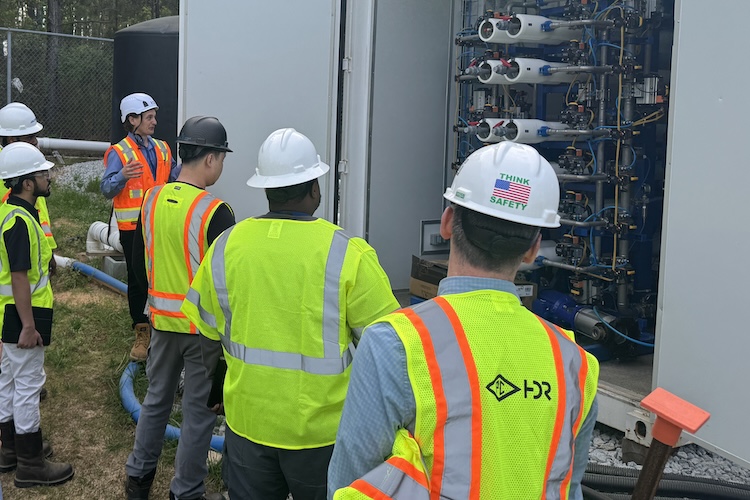
A collaborative team does not simply hand off work between phases but carries shared knowledge forward. During installation and start-up of PFAS piloting, that integration pays dividends. Engineers ensure systems are sized and connected correctly. Contractors manage site conditions, utility connections, and access. Owners build operational familiarity with each system so their staff can monitor performance, respond to issues, and understand what full-scale operation will require. The tasks are role specific, but the accountability is shared.
The Right People Reduce Downtime
Keeping systems running during piloting or commissioning often requires mechanical, electrical, and field maintenance expertise on short notice. When that expertise is already embedded in the project team, problems get diagnosed faster and units get back online sooner. This is especially true when pilot units are configured in series (e.g., an ultrafiltration pretreatment member followed by reverse osmosis). A single small issue can take an entire train offline. Collaborative delivery reduces that risk by having the right people to maintain the many individual components needed to keep the pilot units operating and collecting data.
Collaborative delivery improves project outcomes by aligning the owner, designer, and contractor early; integrating cost, constructability, and design decisions throughout; and carrying that shared knowledge from planning through construction and into operations. The more critical and complex the work, the more critical collaboration becomes. It is a practical strategy for reducing risk, protecting schedules, and making better long-term decisions.